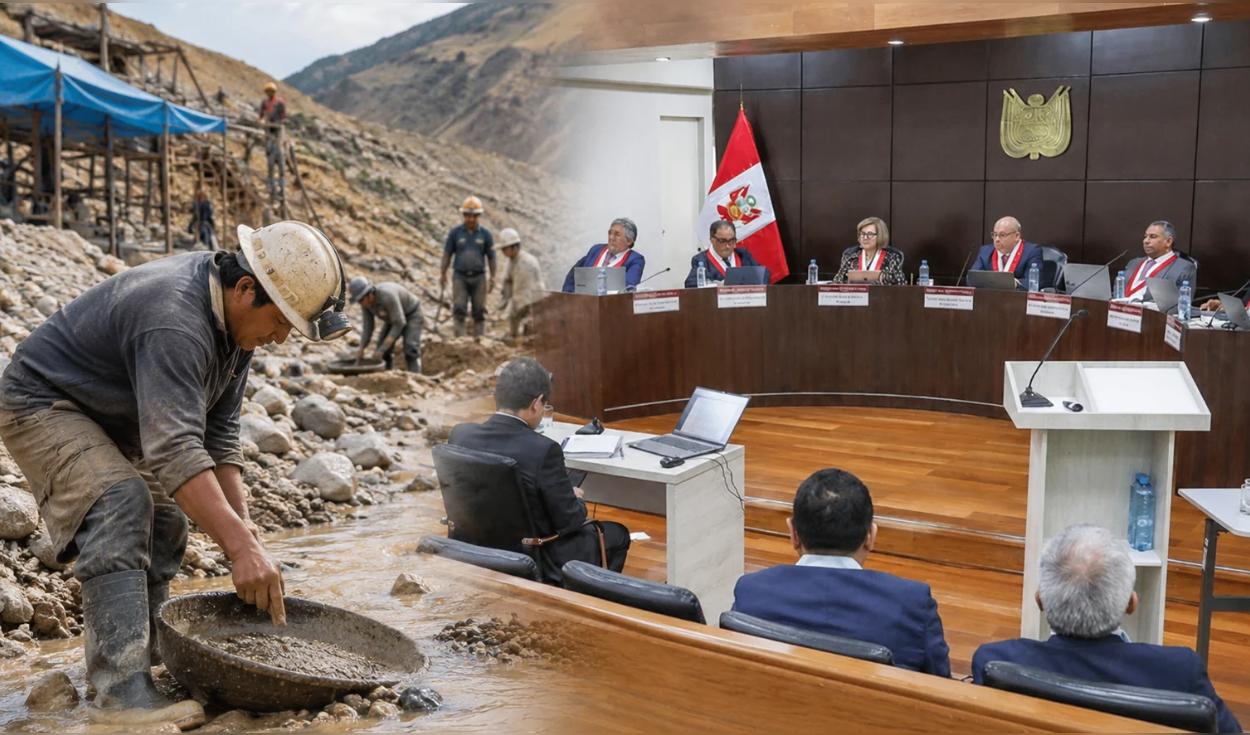
Only 66 people completed Peru's mining formalization process between 2025 and 2026, Luis Alberto Huerta Guerrero, the public prosecutor specializing in constitutional matters for the Executive branch, told the Constitutional Court during a hearing held on Thursday.
The figure emerged as judges examined a lawsuit filed by the Bar Association of Loreto challenging the latest extension of the Comprehensive Registry for Mining Formalization, known as Reinfo. The lawsuit argues that prolonging the registry is incompatible with the state's constitutional duties to protect the environment and pursue illegal mining.
The low number of completed cases highlights the limited results of a process that has dragged on for years, leaving thousands of registered operators without having met the requirements needed to obtain formal status.
Congress reports nearly 30,000 pending files
Juan Carlos Prado Herrera, representing Congress at the hearing, said 29,580 files remained active in the formalization process in 2025. He said registrants still had to submit environmental management instruments, archaeological documentation and exploitation contracts to complete their applications.
That figure refers to files, not people, so it cannot be compared directly with the 66 individuals the Executive's prosecutor said had completed the process. Even so, both figures underscored the gap between the volume of pending paperwork and the actual results of formalization.
Prado Herrera also said part of the delay stemmed from regional governments, which are responsible for processing the applications. He said the technical and administrative capacity of these bodies affects how quickly registrants can meet the requirements for formal status.
Debate over criminal liability shield
The hearing also addressed the scope of Article 307-A of the Penal Code, which defines the crime of illegal mining and exempts from criminal liability those who are undergoing formalization. At issue is whether this exemption will stop applying when Reinfo expires on December 31, or whether it could continue for miners who move into the new formalization regime for small-scale and artisanal mining, known as MAPE.
Samuel Abad Yupanqui, the lawyer representing the Bar Association of Loreto, argued that the end of the registry would not necessarily remove the exemption. He said Article 307-A does not explicitly refer to Reinfo but to those undergoing formalization, so registrants who move to the new regime and keep that status could continue to invoke the provision.
Huerta Guerrero, the Executive's prosecutor, defended a different interpretation, arguing that the exemption is tied to Reinfo and will stop applying once the registry expires. Pedro Hernández Chávez, the president of the Constitutional Court, questioned whether that interpretation was sufficient, noting that the text of Article 307-A does not explicitly state that the provision ends along with the registry.
The discussion also touched on the proposed MAPE law, which would create a new framework for formalizing small-scale and artisanal mining. The concern raised was that if the new regime allows the formalization process to continue under similar conditions, the criminal exemption could remain in place despite Reinfo's closure. The Constitutional Court has not yet issued a ruling on how the provision will apply once the registry ends.
Case against Reinfo extension law left pending
The case, filed under docket number 00009-2026-PI/TC, concerns the lawsuit of unconstitutionality brought by the Bar Association of Loreto against Law 32537, which established the most recent extension of the mining formalization process. The association argues that extending the registry is incompatible with the state's constitutional obligations to protect the environment and prosecute illegal activity.
During the hearing, representatives of Congress and the Executive defended the law, while the plaintiffs raised concerns about the effects of keeping Reinfo in force. Among their arguments was that successive extensions have prolonged what was meant to be a temporary mechanism without resolving the difficulties preventing registrants from completing their formalization.
At the close of the session, the Constitutional Court left the case pending a vote. The judges must now issue a ruling on the constitutionality of the challenged law. In the meantime, the figure presented by the Executive and the debate over the registry's criminal effects highlight some of the central questions surrounding Peru's mining formalization process.
What happens next
The Constitutional Court judges must vote and issue a ruling on the constitutionality of the challenged law extending Reinfo. The registry itself is scheduled to expire on December 31.
Test yourself
According to the public prosecutor for the Executive branch, how many people completed Peru's mining formalization process between 2025 and 2026?
On what grounds did the Bar Association of Loreto challenge the extension of Reinfo?
What legal protection under Article 307-A of the Penal Code was debated during the Constitutional Court hearing?
Have your say
Should Peru continue to extend its mining formalization registry (Reinfo)?