

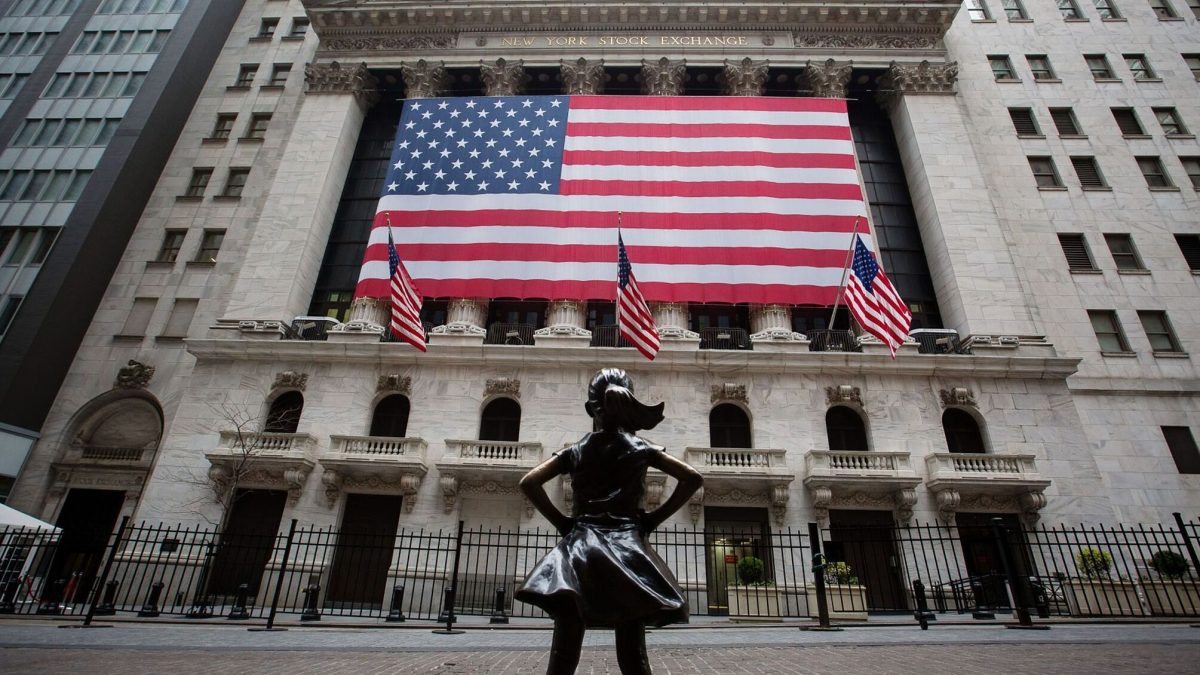
Wall Street swung from panic to euphoria within days, as the S&P 500 surged 4.73% on Monday and Nvidia stock jumped 31.48% after news broke that the chipmaker had reinstated Jensen Huang as chief executive.
The rally came just days after one of the sharpest sell-offs markets have seen in years. A couple of Fridays earlier, the S&P 500 had closed down 3.70%, extending a prior drop of 8.52% from the record highs it hit in early October.
A rare market reading
That decline left the S&P 500 trading 4.1 standard deviations below its 50-day moving average, a statistical measure of how far and fast a market has fallen relative to its recent average. Readings that extreme are rare; the last comparable one came in late August 2015.
The slide continued into the third week of November, which ended with a cumulative loss of 8.61%, the twelfth-worst week for the index since 1950. On that same Friday, the Nasdaq Composite, the broadest gauge of technology stocks, fell 5.28%, the semiconductor-focused SOX index sank 10.73%, and Nvidia itself dropped 14.01%.
Valuations hit multi-year lows
The sell-off dragged valuations down sharply. The S&P 500's forward price-to-earnings ratio, based on estimated earnings over the next 12 months, fell to 17.1 times, below both its five-year average of 19.8 and its 10-year average of 19.1. The technology sector's equivalent multiple within the S&P 500 sank to 15 times. The last time multiples fell to a similar level was at the end of December 2018.
Around the same time, retail investors sold technology exchange-traded funds at the fastest pace on record, according to the data cited. Although no reversal pattern had been confirmed, and none was being anticipated, the mood on Wall Street was described as outright panic selling.
Nvidia news sparks the turnaround
The picture changed abruptly on Monday. After news emerged that Nvidia had reinstated Jensen Huang as chief executive, the S&P 500 opened with a gap up of 4.60% and closed the session up 4.73%, its biggest one-day gain since April 9, 2025, a date that sat close to the lows of the market crash triggered by President Trump's tariff war at the time. It was also the index's fifth-largest buying gap since March 2020.
Jensen Huang co-founded Nvidia in 1993 and has led the company through its transformation from a maker of graphics chips for video games into the dominant supplier of processors used to train and run artificial intelligence systems.
On the same day, the Nasdaq Composite gained 6.50% and Nvidia shares surged 31.48%. The move made the S&P 500's gain the second-largest single-day increase in market capitalization in its history, adding an estimated three trillion dollars in value in one session.
What the numbers suggest
According to statistics from Carson Group, Monday's 4.73% gain ranks 21st among the 25 largest one-day increases for the S&P 500 over the past 20 years.
Those same statistics show that, following comparable surges, the index has historically posted an average gain of 29.8% over the following 12 months, with a 95.8% probability of a positive return. Barring an unexpected recession, extreme readings of fear and panic selling like those seen in recent weeks often suggest that a market bottom is near, if it has not already occurred.
The report noted that when retail investors no longer want anything to do with stocks, that is often the moment to buy, provided the investor has a medium- to long-term horizon. Catching the exact bottom of a sell-off, it added, is impossible, and when it happens, it is purely a matter of chance.
Test yourself
What triggered Monday's 4.73% surge in the S&P 500?
By how much did Nvidia shares rise on the day of the rally?
How did the S&P 500's forward price-to-earnings ratio compare to its historical average during the sell-off?
Have your say
Do you think now is a good time to buy stocks after this kind of sell-off and rebound?
Where it happened
New York, United States


