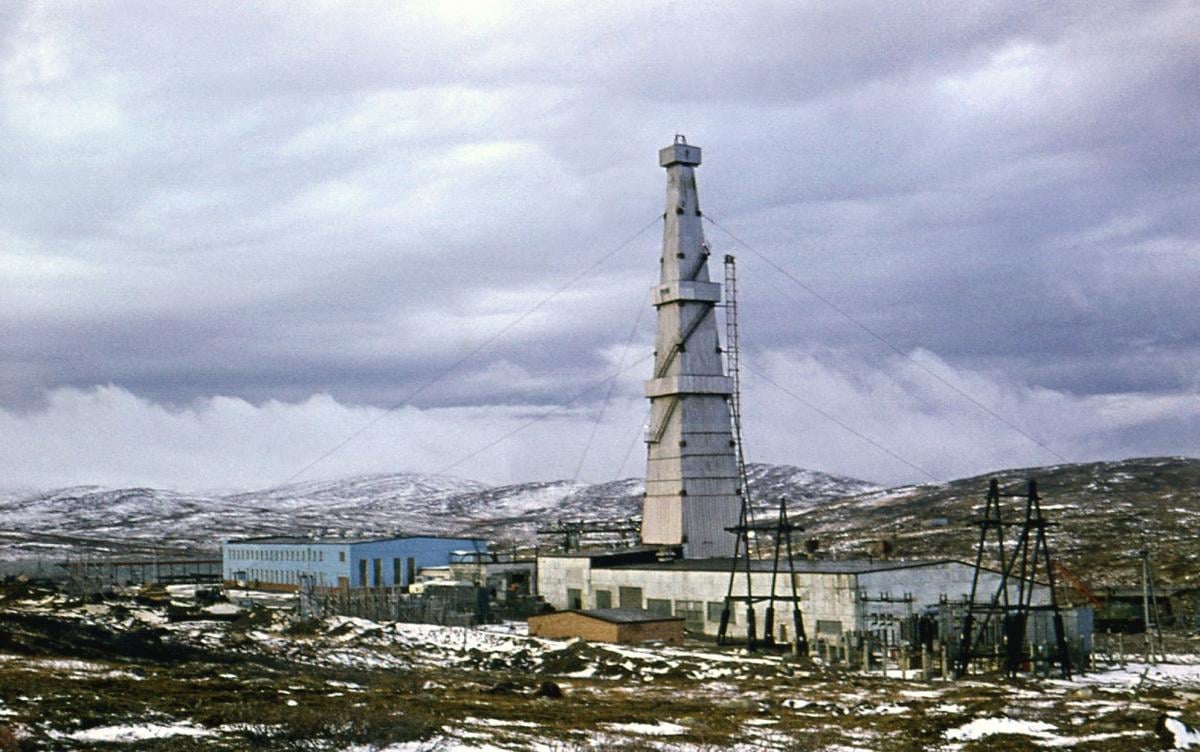
The deepest hole ever drilled into the Earth reached 12,262 meters into the Kola Peninsula in northwestern Russia in 1989, a project that took nearly two decades and covered just 0.19% of the distance from the planet's surface to its center, according to Space Daily.
Work on the Kola Superdeep Borehole began in 1970 under the Soviet Union. By the time active drilling stopped in the early 1990s, the project had advanced roughly 0.19% of the way toward Earth's core, a figure that reflects a scientific mission that was never meant to reach the planet's center.
The common explanation for why drilling stopped is that the rock became so hot and pliable that it flowed back into the hole. That is broadly true but needs qualifying, Space Daily reported. The rock was not molten, and the borehole was never an open shaft that material could travel through. Instead, heat and pressure caused the surrounding crystalline rock to deform slowly, narrowing or sealing sections of a hole that was barely wider than a dinner plate.
Modern oil and gas wells have already exceeded 12,262 kilometers when measured along the full path of their wellbore, since many curve and run horizontally through a reservoir, making their measured length far greater than their depth below the surface. Even so, the American Association of Petroleum Geologists still regards the Kola borehole as the deepest hole ever drilled vertically into the Earth.
An engineering challenge beneath the surface
The Kola borehole did not descend as a single straight pipe. Equipment repeatedly became stuck, branches were abandoned, and new side shafts were started from shallower points as varying rock hardness deflected the drill.
A history of the project written by Charlotte Riggle in 2023 noted that drillers described the main shaft as a slightly wavy curve twisted into an elongated spiral. The deepest branch was kept within about 10 degrees of vertical, but its actual path was longer than the true vertical depth. The simplified straight line often used to illustrate the borehole is a measurement convention, not the physical shape of the hole.
Hot rock can move without melting
At the surface, crystalline rock appears rigid. At depth, it sits under the weight of kilometers of overlying crust, and heat encourages it to deform slowly. Drilling a borehole removes material that had been supporting part of that load, creating a small opening that the surrounding rock tends to close back up.
Published figures for the temperature at the bottom of the hole vary. Scientific American has reported a temperature of about 180C, while a 2026 review in the journal Communications Earth & Environment puts it at 212C. The exact number depends on the measurement and the source cited, but the engineering conclusion is the same: temperatures at depth turned out to be far higher than the drilling program had anticipated.
Under those conditions the rock behaved plastically, deforming rather than standing as a rigid, brittle wall. A recent review describes this plastic behavior repeatedly sealing the hole shut. Pipes and drill bits also had to withstand the heat, an enormous load, and a round trip measured in tens of kilometers every time equipment needed replacing.
Material from the European Geosciences Union notes that drill bits could wear out after as little as seven to ten meters of drilling. Replacing one meant raising a drill string roughly 12 kilometers long and weighing about 200 tons. Near the record depth, one more meter was never just another meter.
The 0.19% comparison is correct but incomplete
Earth's average radius is about 6,371 kilometers, based on NASA's comparison of Earth and the Moon. Dividing the Kola borehole's 12.262 kilometers by that radius gives a result of about 0.001925, or 0.1925%.
That calculation can give the impression the project fell 99.8% short of a planned journey to Earth's center, but no such journey was ever planned. The goal was to collect samples and study the continental crust, with an initial target depth of 15 kilometers. The planet's center was never an engineering destination.
A more relevant, and still unreached, boundary is the Mohorovicic discontinuity, or Moho, which marks the transition between the crust and the mantle. The Kola borehole never reached it. Continental crust is tens of kilometers thick and varies in thickness by location, so drilling from land left a considerable distance still to go. Oceanic crust is thinner, which is why proposals to drill into the mantle are usually made from a ship, despite the added difficulty of working through kilometers of water first.
The borehole confirmed what seismic waves had suggested
Two decades of drilling did not cover much distance on a planetary scale, but they produced direct physical evidence. Geologists typically map deep structure using seismic waves, gravity, magnetism, and rock exposed by tectonic processes. A borehole, by contrast, can supply actual core samples and allow measurements to be taken within the crust itself. The Kola program extracted thousands of core samples from rock billions of years old.
A 1986 report from the United States Geological Survey on the Soviet project documented early results while the Kola borehole was still active. Later studies found that a seismic boundary expected to mark the transition from granite to basalt did not match the smooth compositional change predicted for that location. Instead, a 2026 review describes a continuous transition into an ancient granite-gneiss basement, where seismic discontinuities reflect metamorphic, structural, and mechanical contrasts rather than a clean change in rock type.
The borehole also encountered fractured rock carrying fluids at depths where earlier models had predicted a relatively sealed crust. The Kola borehole did not provide a universal cross-section of every continent, but it showed why indirect measurements need to be checked with physical drilling.
Why the old record still matters
A 2026 review by Guanyu Zhu and Haiping Huang places the Kola borehole alongside more recent Chinese boreholes that have also passed 10 kilometers in depth. Modern projects use better materials, drilling fluids, downhole instruments, and directional control systems, but the core difficulties of drilling at extreme depth remain: temperature rises, pressure increases, equipment takes longer to travel between the surface and the drill bit, and an open borehole becomes harder to keep from closing.
No borehole has yet crossed the Moho or brought unaltered mantle material to the surface. Today's ultra-deep drilling projects tend to target narrower questions about crustal structure, geothermal heat, deep fluids, carbon storage, and energy resources, rather than a route to the planet's core.
At 12.262 kilometers, the Kola Superdeep Borehole is a small fraction of Earth's radius. But as a continuous record of measurements and samples from continental crust, it remains a depth that no later vertical borehole has matched.