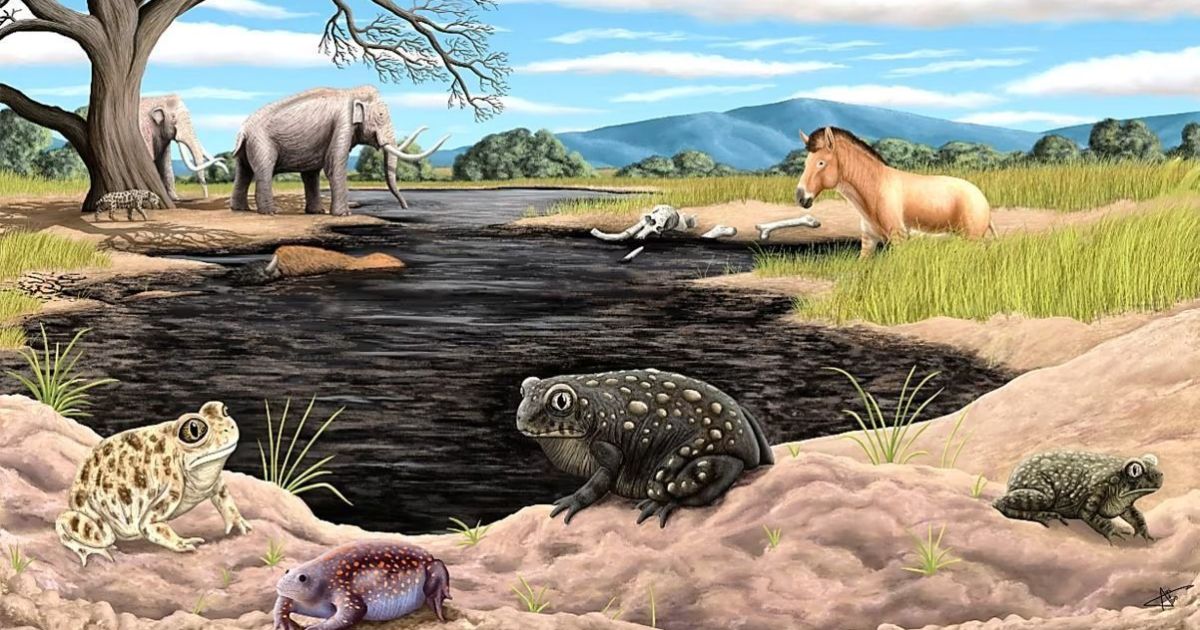
Scientists in Los Angeles have discovered an extinct Ice Age spadefoot toad named Spea labreae from fossils stored at the La Brea Tar Pits.
The findings, published on Wednesday in the Journal of Vertebrate Paleontology, represent only the second extinct Pleistocene amphibian ever identified in North America. The Pleistocene epoch spanned from about 2.58 million to 11,700 years ago, a period known for large ice age mammals.
Researchers identified two distinct fossil fragments of the animal's sacro-urostyle, a specialized bone structure in amphibians that fuses the sacral vertebra to the tail vertebrae and connects the lower spine to the hips. The specimens were originally excavated from the tar pits in 1929 but had remained unstudied in museum storage.
Fossils unexamined since 1929 excavation
Because smaller animal bones often receive less attention during excavations than the remains of giant mammoths, mastodons, sabre-toothed cats and dire wolves, the fragments lay unexamined until 2023. Dr. J. Alberto Cruz, lead author of the study, began examining the collection that year and said he did not expect to discover a new species.
Cruz said he considers himself primarily a paleoecologist and paleogeographer rather than a taxonomist, describing the discovery of his first new species as very exciting. Cruz serves as a research associate at the La Brea Tar Pits and a researcher at the Quinametzin Paleontological Research Center in Mexico, an institution operated by the National Institute of Anthropology and History.

Amphibian bones are small, fragile and rarely preserved in geological deposits. The natural asphalt pits in Los Angeles excel at fossil preservation by protecting organic remains from erosion, decay, scavengers, water, oxygen, sunlight and microbial activity, with the sticky asphalt acting like flypaper to trap organisms.
Insights into prehistoric climate
Because amphibians depend on nearby water sources and rarely travel far from their habitats, Cruz said the fossils offer valuable insights into the prehistoric climate of Los Angeles. He noted that understanding how past environmental changes affected ancient amphibians could help researchers design better strategies to protect modern endangered species.
Cruz measured the tiny fossil fragments, each about 1 centimetre (0.4 inches) long, and compared them against other amphibian bones in the La Brea collection. He also evaluated 80 specimens from the Herpetology Collections at the Natural History Museum of Los Angeles County and the Museum of Vertebrate Zoology at the University of California, Berkeley.
The comparative analysis revealed key anatomical distinctions in the fossil, including an axe-shaped portion of the sacro-urostyle that was significantly smaller than corresponding structures in other spadefoot toad species, confirming it belonged to a previously unknown species.

Age and significance of the discovery
Scientists cannot date the delicate fossils directly without destroying them. However, researchers determined the toad lived within the past 60,000 years based on the active period during which the asphalt deposits have trapped organisms in the area.
Dr. Emily Lindsey, study co-author and curator and site director of the Samuel Oschin Center for Global Ice Age Research at the La Brea Tar Pits, said the discovery doubles the number of known extinct Ice Age amphibians in North America, calling it a major milestone for paleontology.
Lindsey explained that researchers rarely bothered to collect microfossils prior to the late 20th century, causing smaller remains to be widely overlooked during early excavations around the world. The discovery underscores the scientific value of re-examining historical museum collections.