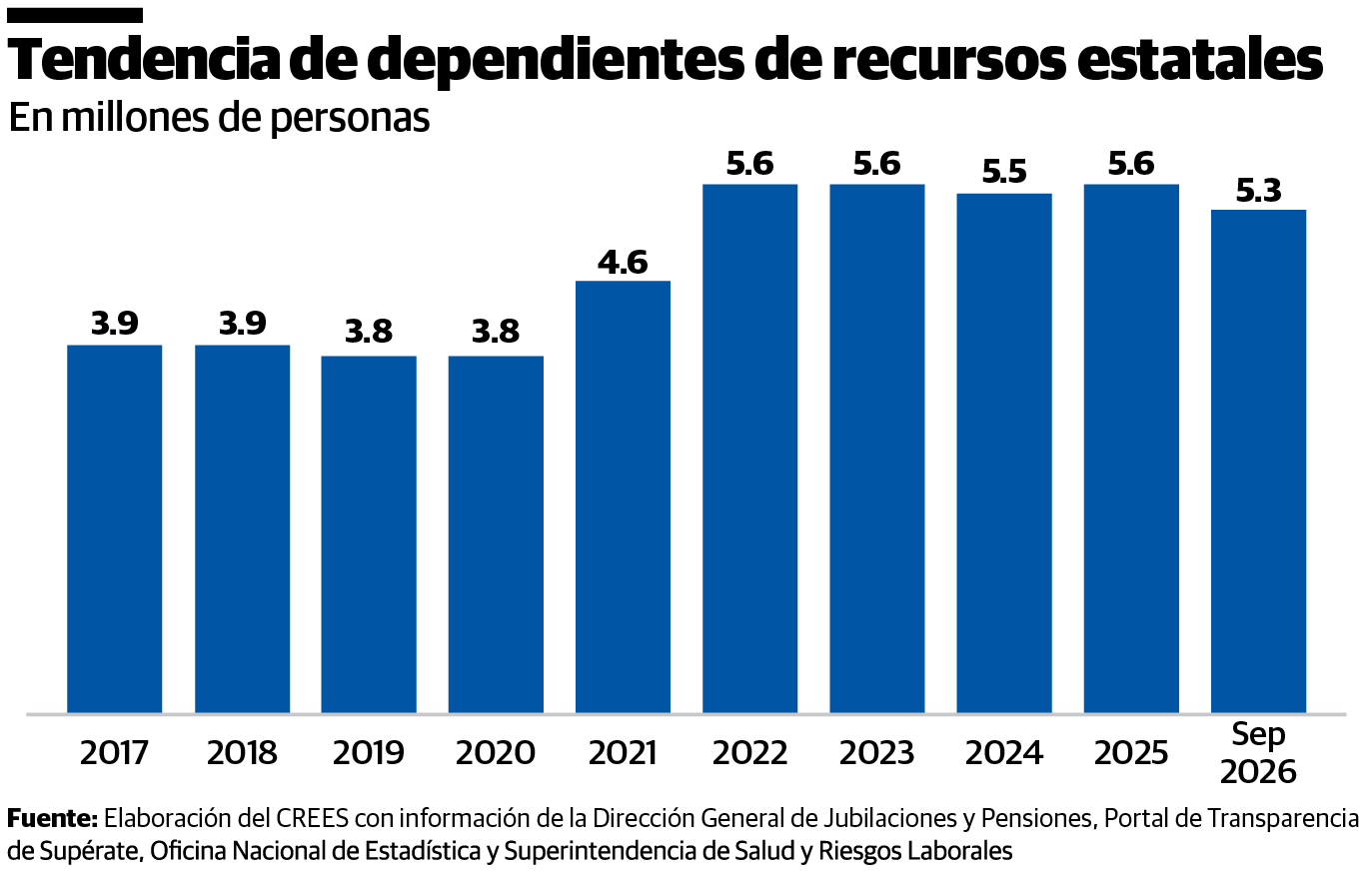
More than 5.3 million people in the Dominican Republic depended economically on the state as of September 2026, according to an analysis by the Centro Regional de Estrategias Económicas Sostenibles (Crees). Based on the trend of previous years, the organization expects that figure to have surpassed 5.5 million by the end of the year.

It is the fifth consecutive year that the number of state dependents has exceeded five million. Through September, an average of 48.1% of the Dominican population received a recurring monthly transfer, salary or pension from public funds, Crees said.
How the figures are calculated
Crees, which has published the analysis since 2019, defines a state dependent using three categories of recipients. The first is the number of household members receiving the largest state subsidy, the Aliméntate program. The second is retirees drawing a state pension, based on figures from the Dirección General de Jubilaciones y Pensiones a cargo del Estado (DGJP), the government agency that oversees public pensions. The third is public sector workers who contribute to the Dominican Social Security System, using data from the Superintendencia de Riesgos Laborales (Sisalril).
Growth of the Aliméntate program
The Aliméntate program, formerly known as Comer es Primero, reached 825,275 households in 2019. In the July to September quarter of this year, the average number of beneficiary households climbed to 1,489,960, according to the Crees analysis.
That increase stands in contrast to the Dominican Republic's poverty statistics. Crees noted that as poverty rates fall, subsidy spending would normally be expected to decline as well, but that has not happened, because the drop in poverty is itself largely explained by subsidies and public sector jobs.
A debate over how poverty is being reduced
Crees argued that when the state makes monthly payments funded by public debt and taxes, it is transferring resources rather than creating wealth. People who receive the money are not poorer in terms of new income generated in the economy, the analysis said, because someone else, now or in the future, ultimately bears the cost of financing those transfers to households. Crees described the transfers as partly intragroup, since the poor also pay taxes.
According to Crees, genuine poverty reduction should be grounded in production, which it called the original source of income in an economy. Any other rise in income through transfers, including public salaries and pensions, is a political measure that Crees said is not based on economic principles, whatever defenders it may have.
What the 2027 budget sets aside
Crees said it should be a headline finding that consolidated remuneration spending in the draft 2027 budget will total 563 billion pesos, equivalent to 40.5% of estimated tax revenue. Pensions and retirement payments for the central government are projected at 114 billion pesos, while social assistance programs, which include Supérate, are budgeted at 54 billion pesos.
Crees said the cost of providing a monthly income to more than five million people is part of the Dominican Republic's fiscal problem. It has also become a social problem, the analysis said, since almost half of Dominicans now maintain a relationship of dependency with the country's political class.
Test yourself
How many people in the Dominican Republic depended economically on the state as of September 2026, per Crees?
What share of the Dominican population received an average monthly transfer, salary or pension by September 2026?
How much does the proposed 2027 budget allocate to consolidated remuneration spending?
Have your say
Should the Dominican government work to reduce the number of citizens depending on state salaries, pensions and subsidies?
Where it happened
Santo Domingo, Dominican Republic