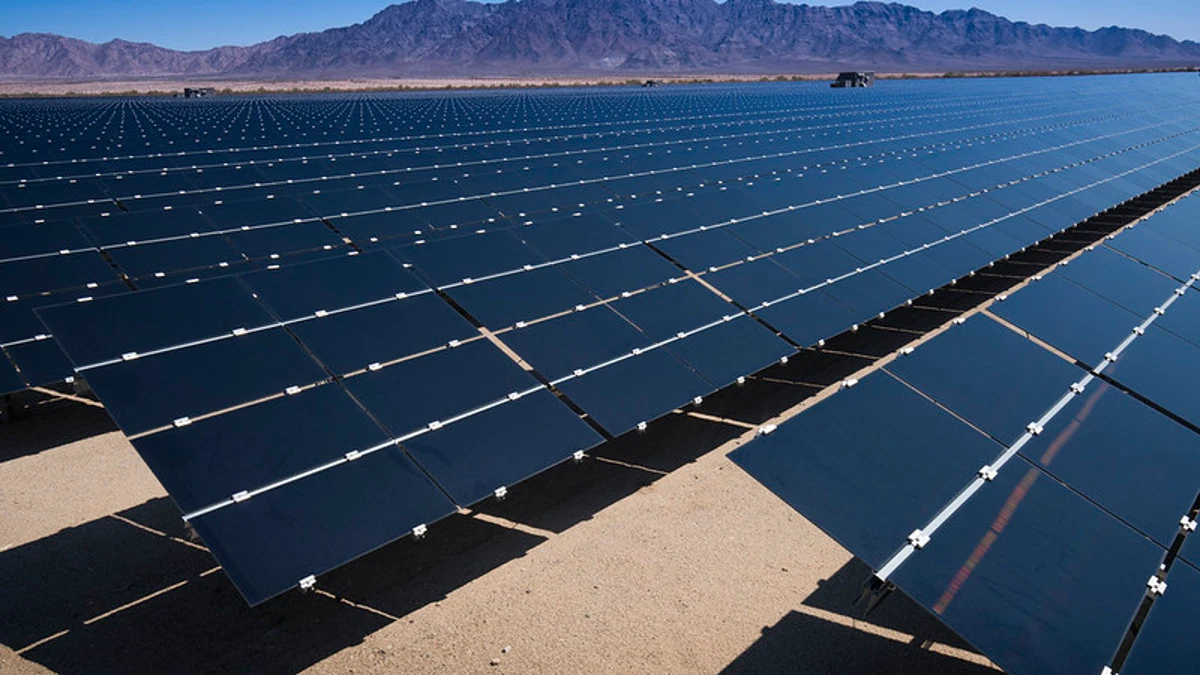
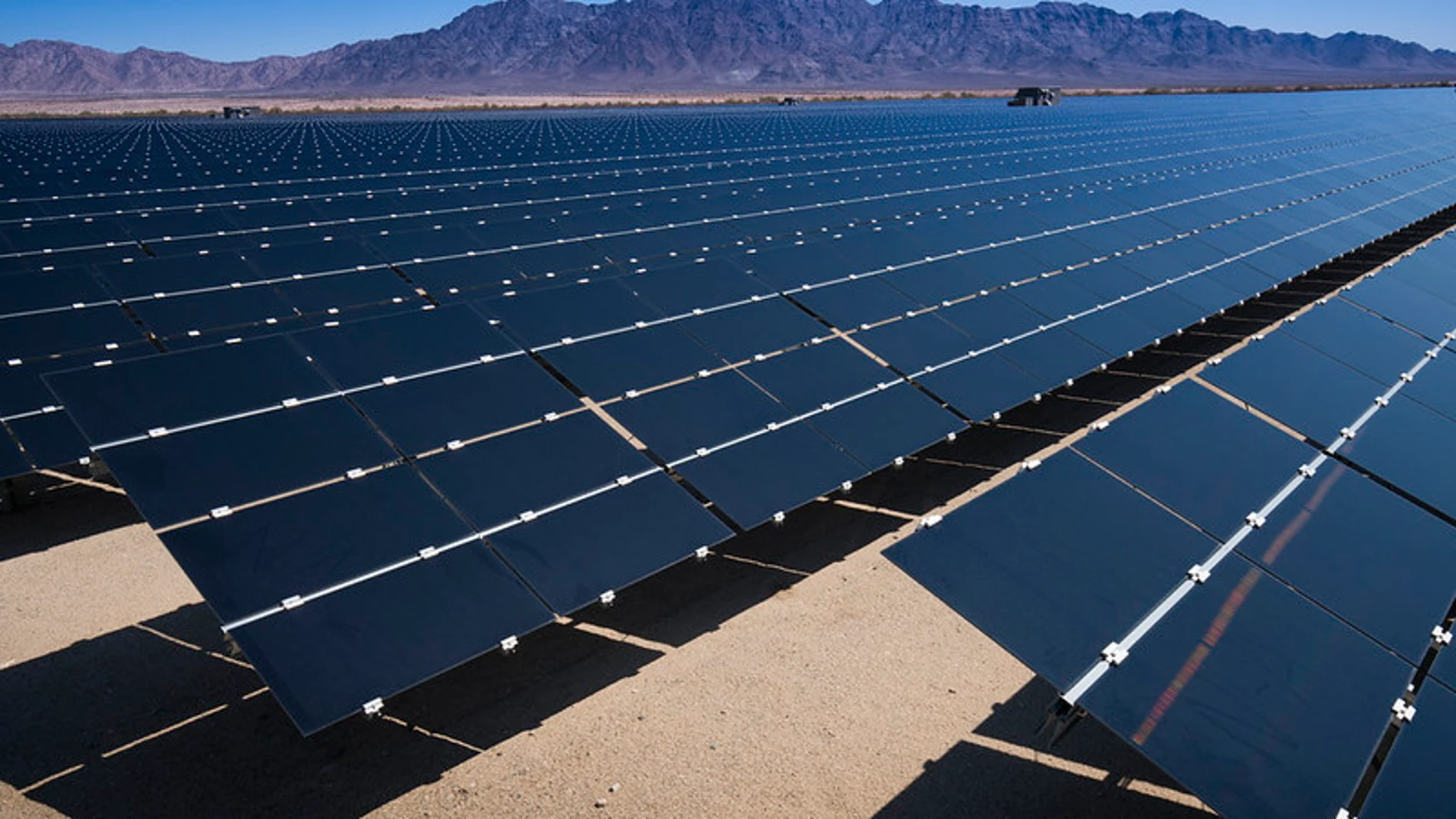
A hypothetical network of solar farms spread across the Sahara Desert with a combined capacity of one terawatt could generate about 1,800 terawatt-hours (TWh) of electricity a year, enough to meet roughly 5.7% of global electricity demand, according to a recent scenario analysis.
The Sahara covers more than nine million square kilometres and receives an extraordinary amount of solar radiation, which has long made it a target for ambitious renewable energy proposals. The exercise outlined in the analysis is not a single power plant but a web of installations distributed across the desert, using a reference figure of 1,800 kilowatt-hours of output per kilowatt of installed capacity each year.
Global electricity demand reached 31,779 TWh in 2025, according to data from the consultancy Ember. A one-terawatt Saharan array would therefore produce an amount of electricity comparable to what many countries combined currently use, even though it would fall well short of powering the planet on its own.
Comparing Africa and the European Union
The comparison becomes sharper when set against regional demand. Africa used around 1,000 TWh of electricity in 2025, while the European Union consumed about 2,774 TWh. On paper, the Saharan array could generate almost 1.8 times the electricity Africa uses in a year, or cover roughly two-thirds of the EU's annual electricity demand.
The land footprint required for one terawatt of capacity, based on the density of large fixed-axis photovoltaic installations studied in the United States, would be around 11,400 square kilometres, about 0.12% of the Sahara's total surface area. That figure is not fixed, the analysis notes, since it depends on the spacing between panel rows, the technology used, terrain and the layout of each individual solar park.
The scale of hardware involved would also be immense. Using commercial 500-watt panels, the project would require around two billion modules; with 600-watt panels, about 1.67 billion. Beyond the panels themselves, the array would need inverters, substations, transmission lines and storage systems capable of managing output that depends entirely on sunlight.
The problem of storage and transport
That dependence on sunlight is the first major obstacle. A photovoltaic plant can generate huge amounts of electricity over a year yet produce nothing at night, and its output drops when clouds pass or seasons change. Turning that generation into a reliable supply would require batteries, additional generation sources and transmission networks capable of carrying power from North Africa to distant centres of consumption.
High-voltage direct current lines would allow electricity to travel long distances, but building them would demand major international investment and infrastructure of considerable complexity.
There is also the question of how much energy it takes to manufacture the panels in the first place, and how long they take to pay that energy back. The German institute Fraunhofer ISE estimates that a photovoltaic installation in southern Europe needs about 0.9 years to recover the energy used in its manufacture and installation. Over twenty years of operation, a crystalline silicon system can produce around twenty times the energy invested in it, a measure known as energy return on investment rather than financial return. That timeline cannot automatically be applied to the Sahara, since it depends on the technology, the location and operating conditions.
Climate effects of covering the desert
The desert cannot be treated as an empty space either. A study published in the journal Geophysical Research Letters modelled what would happen if large areas of the Sahara were covered with solar installations. The models pointed to increased rainfall and vegetation in some areas, but also to distant climate effects, including drought in the Amazon and changes to global temperature and sea ice. These are not observed consequences of a real installation but results from modelled climate scenarios, the analysis notes, though they are a reminder that transforming such a large surface area could disturb the balance between land, atmosphere and ocean circulation.
What the scenario would mean for Spain
The analysis also applies the same exercise to Spain. The municipality of Tabernas, in the province of Almeria, covers about 280 square kilometres. If that entire area were covered in solar panels at the same density used in the Saharan scenario, it could host about 24.6 gigawatts of photovoltaic capacity. At a production rate of 1,800 kWh per kWp a year, that would generate about 44 TWh annually, equivalent to around 16% of Spain's 2025 electricity demand of 269.8 TWh including self-consumption, according to Red Electrica.
The comparison is purely mathematical. The Tabernas Desert Natural Site, protected for its exceptional geological and biological value, covers about 114.5 square kilometres and is home to species with highly restricted ranges. It is not land available for such an installation.
The Sahara could become an extraordinary source of clean electricity, the analysis concludes, but the challenge is not only collecting sunlight. It is storing it, transporting it and distributing it without unpredictably disrupting ecosystems and climate. The resource appears inexhaustible. Harnessing it is a different matter entirely.
Test yourself
What share of global electricity demand could a one-terawatt Saharan solar array theoretically meet?
According to Fraunhofer ISE, how long does a southern European solar installation take to recover the energy used to build it?
Why is the Tabernas Desert Natural Site in Almeria not actually available for a large-scale solar installation, according to the article?
Have your say
Should large-scale solar projects be built in desert regions like the Sahara?