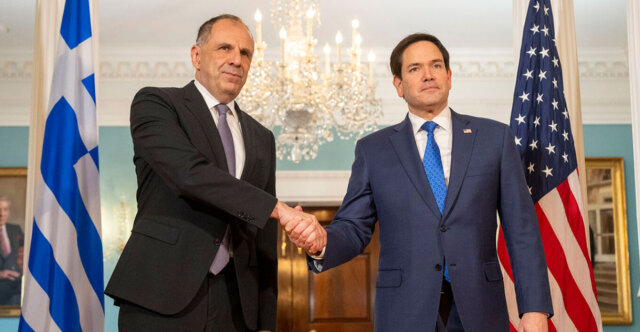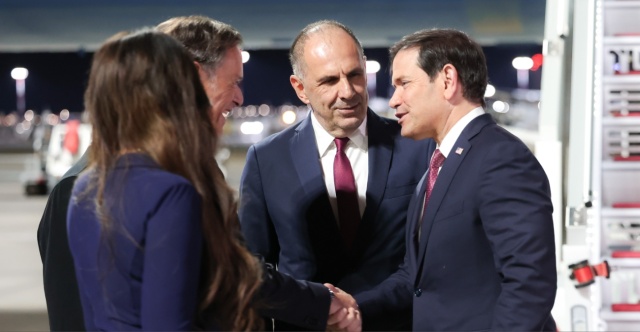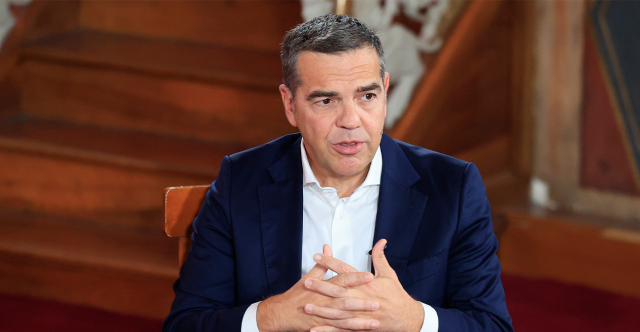
Former Greek Prime Minister Alexis Tsipras has described the government decision to host US Secretary of State Marco Rubio for a speech at the Pnyx in Athens as a risky and very bold choice. Speaking at the Vima conference on Wednesday, the leader of the Greek Left Alignment questioned whether Washington genuinely supports Greek national interests and international law.
Tsipras noted that giving a foreign minister access to speak at the ancient assembly grounds has occurred only once before in modern history, when France's culture minister addressed the site in 1959. He added that during his own tenure as prime minister he invited French President Emmanuel Macron to speak at the Pnyx, while former US President Barack Obama was also scheduled to speak there before choosing the Stavros Niarchos Foundation Cultural Center due to security concerns.
Highlighting that Greece is the birthplace of democracy, Tsipras warned that democratic values are currently threatened by the rise of the far right and an extreme belief that might makes right. He argued that such a mindset directly contradicts the spirit of the Pnyx.
The former prime minister pointed out that the MAGA movement represented by Donald Trump has repeatedly taken positions at the absolute limits regarding democracy and national sovereignty, stating that the storming of the US Capitol does not align with democratic principles. He said that if the secretary of state remains strictly within his diplomatic role without making ideologically charged statements, no issue will arise, but warned that the government will bear the blame if the outcome differs.
h2>Undersea cable and strategic dialogue
Addressing the sixth round of the Greece-US strategic dialogue, Tsipras acknowledged the value of bilateral talks but recalled that previous rounds produced the EastMed pipeline project, which was subsequently shelved. He emphasized that the focus should not merely be on holding dialogue, but on evaluating its concrete results.
Tsipras expressed deep concern over Rubio's initial statements following a meeting with Greek Foreign Minister Nikos Dendias regarding a planned undersea telecommunications cable. He explained that under the United Nations Convention on the Law of the Sea, submarine telecommunications cables do not require approval from neighboring countries even if they pass through another nation's continental shelf, unlike energy pipelines.
Critiquing Rubio's response that the cable issue involves multiple countries and would be discussed privately, Tsipras likened the American stance to that of Pontius Pilate by refusing to take a clear position. He warned that while diplomatic visits often yield photos and speeches, the primary beneficiary may be the United States seeking new arms sales to Greece rather than Greece securing firm backing for international law.
Progressive coalition and political strategy
Looking ahead to future national elections, Tsipras set the formation of a progressive government as his primary objective. He stated that if the Greek electorate returns him to office, he will seek to build a radical and progressive administration offering a realistic alternative to the right-wing neoliberal policies of Prime Minister Kyriakos Mitsotakis.
Tsipras expressed willingness to cooperate with all democratic and progressive political forces willing to engage in dialogue based on a shared program. He declared that his goal is to unite the broader center-left rather than divide it, adding that he is prepared to maintain the patience of a Buddhist monk even when facing low blows from political rivals.
Housing crisis and urban green spaces
Tsipras sharply criticized the government's response to the country's housing crisis, pointing out that despite seven years in power and five years managing 36 billion euros in EU Recovery Fund allocations, the administration allocated only 1 billion euros to housing and failed to construct a single new home. He contrasted this record with Portugal, which used 14 percent of its recovery funds to construct 26,000 social housing units.
He criticized Mitsotakis for proposing parliamentary measures to extend leases by two years, ban evictions until 2030, and cap rents, noting that similar measures were voted down in Spain by political allies such as Alberto Nunez Feijoo, while Mitsotakis criticized Spanish Prime Minister Pedro Sanchez. Citing official data from the Hellenic Statistical Authority, Tsipras noted that 1.8 million private and public properties currently sit vacant, yet the government lacks official data on public ownership and has failed to introduce incentives to bring them onto the market.
To address the housing shortage, Tsipras called for removing residential properties from the Golden Visa program and proposed a social construction model on public land that provides reasonable contractor profits while expanding affordable public housing stock.
On urban development, Tsipras called for reviving municipal community structures and participatory budgeting. He highlighted that Athens ranks last among 26 European Union capitals in green space, offering just 6.6 square metres of undeveloped green space per resident compared to 36 square metres in Paris and 27 square metres in Madrid.
Tsipras attributed the green space deficit to urban expansion policies dating back to the 1960s, 1970s, and 1980s under the land-for-apartment swap system introduced when the late Konstantinos Karamanlis served as infrastructure minister, noting that neither former mayor Kostas Bakoyannis nor current mayor Haris Doukas created the problem. He advocated for urban regeneration plans, originally conceived during the tenure of Antonis Tritsis, that use higher building density limits outside historical areas to construct taller buildings and preserve ground-level green spaces without obstructing views of the Acropolis.
Tourism management and infrastructure delivery
Regarding tourism, Tsipras stated that Greece does not need fewer visitors, but rather improved infrastructure to balance tourism flows with the daily lives of residents. He called for regulatory controls on short-term rentals such as Airbnb, specifically targeting large foreign corporate buyers purchasing multiple properties rather than individual homeowners.
He also emphasized the need for expanded urban green space and additional underground parking facilities across the capital.
Turning to major infrastructure projects, Tsipras argued that large-scale developments are essential for modern cities, but their execution depends on political will and contractor management. He cited the Thessaloniki Metro, which remained stuck at 30 percent completion for 14 years before his administration advanced construction to 80 percent within three years.
Tsipras accused the current administration of delaying the subway system's opening by four years due to disputes over the Venizelou station antiquities, inflicting traffic congestion and frustration on residents. He also highlighted that his government completed the Patras-Athens-Thessaloniki-Evzonoi highway network without major contractor compensation claims despite bailout restrictions, contrasting this with total public budget costs from contractor delay claims that now exceed 1 billion euros. He concluded by calling for proper long-term management of public works, pointing out that venues built for the 2004 Olympic Games were allowed to decay.